 University of North Texas


TFC Internships Frequently Asked Questions
Day-to-Day
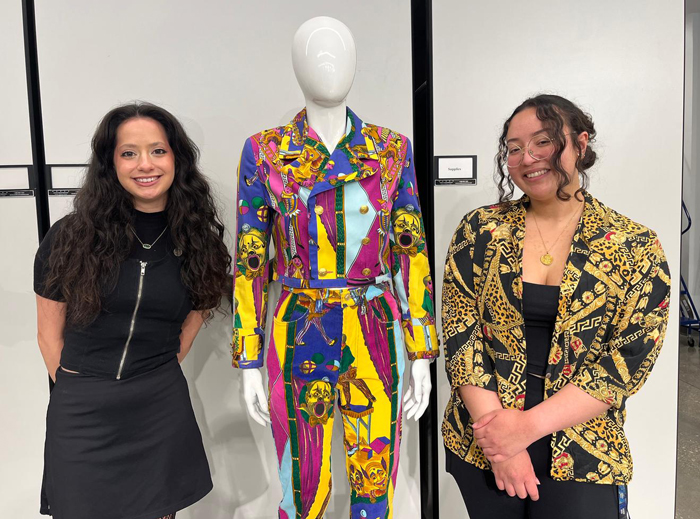
Isabel Saldivar, left and Jessica "Jesi" Worthy present their lecture "Fatal Fashions"
about the history of Versace.
Schedule
- Fall and spring internships tend to start and end with UNT’s semesters, with interns spending seven hours a week at the TFC. Summer internships can have more flexible start and end dates, with the number of hours per week based on the duration of time an intern is available.
- Interns’ individual schedules are set a few weeks before the internship starts, are planned around other regularly occurring commitments they have, such as attending class, employment, volunteering, etc., and are scheduled by the TFC director to overlap with other intern and staff schedules. Once set, the weekly schedule will remain consistent through the entire internship.
Tasks and Projects
- Each intern’s experience is customized to their interests, skills, and goals. No
two interns have the same day-to-day experiences, as no two interns are the same people.
- Interns’ projects are developed in consultation with TFC staff, with a plan or “syllabus”
for the semester outlining important deadlines or steps. These projects engage with
TFC holdings, staff or practices.
- Interns are not employees of the TFC. Their work is not part of the day-to-day tasks of the TFC but instead focused on interns’ professional development.
Application
Cover Letter
Format, length, and tone: This document should follow the conventions of a cover letter, which includes being formatted as a letter and written in a formal tone. Most cover letters are one to two pages long, though there is no minimum or maximum.
Content
- Cover letters are important opportunities to address more fully your background, interests, and goals, especially with information that might not be as apparent in other application materials. (For example, a resume might share an applicant’s major but not a course that has been instrumental in preparing them for an internship.)
- While showing your personality can be important, the strongest cover letters focus not on describing qualities in an employee (e.g., being hard-working or on time for shifts) but instead argue persuasively for the applicant’s motivations for wanting an internship.
- Examples of appropriate content include: the academic or professional training that has prepared you for an internship; how an internship would help you work toward an academic or professional goal, such as a future job or a position in a graduate program; what specific kind of project you want to execute during an internship; and why the TFC is the best place for you to conduct an internship.
What we’re looking for:
Strong applicants who
- Address a clear “why” for their interest in an internship, while less strong applicants merely share that they think an internship would be fun or interesting.
- Share specifics about TFC resources that would help them advance their goals, while less strong applicants share research interests with unclear or no connections to the TFC.
- Demonstrate ways that the structure of an internship would be critical to their development, including sustained focus on a project or dedicated support of TFC staff. Less strong applicants propose projects that could be accomplished in hour-long research appointments or through a shorter professional development conversation.
Writing Sample
Format, length, and tone: There are no requirements for any of these elements, as we encourage applicants from
a wide variety of academic and professional backgrounds who all have different conventions
for sharing their research.
Content
- The best writing samples are good examples of the applicant’s style and tone and display good proofreading and editing. Typically, these are writing samples already created for other purposes, such as something written for a class, a journalism article, an art history research paper, a fashion design process document, or a library science collection-finding aid.
- Content would ideally show some parallel to research proposed at the TFC, though it does not necessarily have to be fashion-focused. For example, a paper about a film might demonstrate how an applicant analyzes visual culture – something they might propose to do during an internship.
What we’re looking for:
- Well-written communication. Good communication is critical to TFC internships, and writing samples offer insight into an applicant’s ability to share their research through writing.
- Writing samples that show depth of thought and demonstrate an applicant’s ability to conduct research, synthesize ideas, and innovate — all components of a TFC internship.
Curriculum Vitae or Resume
Format and length
- We have no minimum nor maximum for this document, though we do encourage applicants to be thorough and not leave out information for, say, the sake of fitting everything on one page. We also do not have a preference for a curriculum vitae or a resume being submitted.
Content
- A curriculum vitae or resume is an important opportunity to outline accomplishments, training, and experience. Though most applicants are early in their careers, most people have worked in some way toward their education and professional goals, and outlining those efforts here is important.
- Strong applicants detail information that gives a sense of how they’ve developed themselves
or sought opportunity. Examples of information that might be included are:
- The degree an applicant is pursuing and names of relevant courses taken
- Scholarships, awards, or other recognition that demonstrates others are valuing the applicant’s efforts
- Participation in relevant events or opportunities, such as inclusion of work in an exhibition, runway show, or event; volunteering at relevant institutions or happenings; or membership or leadership in a club or organization
Remember that application reviewers might not have had your same experiences or exposure.
For example, it’s useful to spell out the names of organizations or institutions rather
than using initials, and offering names of courses rather than course numbers.
What we’re looking for:
- A well-developed CV or resume that demonstrates a commitment to professionalism, no matter the content or length. Strong candidates have organized and clearly presented information in their application.
- Your past academic experiences or opportunities, which help application reviewers understand where applicants are coming from and help frame how the TFC might complement those experiences. For example, seeing that someone has experience in other archives suggests an interest in professional practices at the TFC. Another resume might list many fashion design classes, which signals an interest in design research and creative outputs. These two examples are not considered stronger or weaker than the other, but they do help reviewers think through how our staff and resources might support either path.